








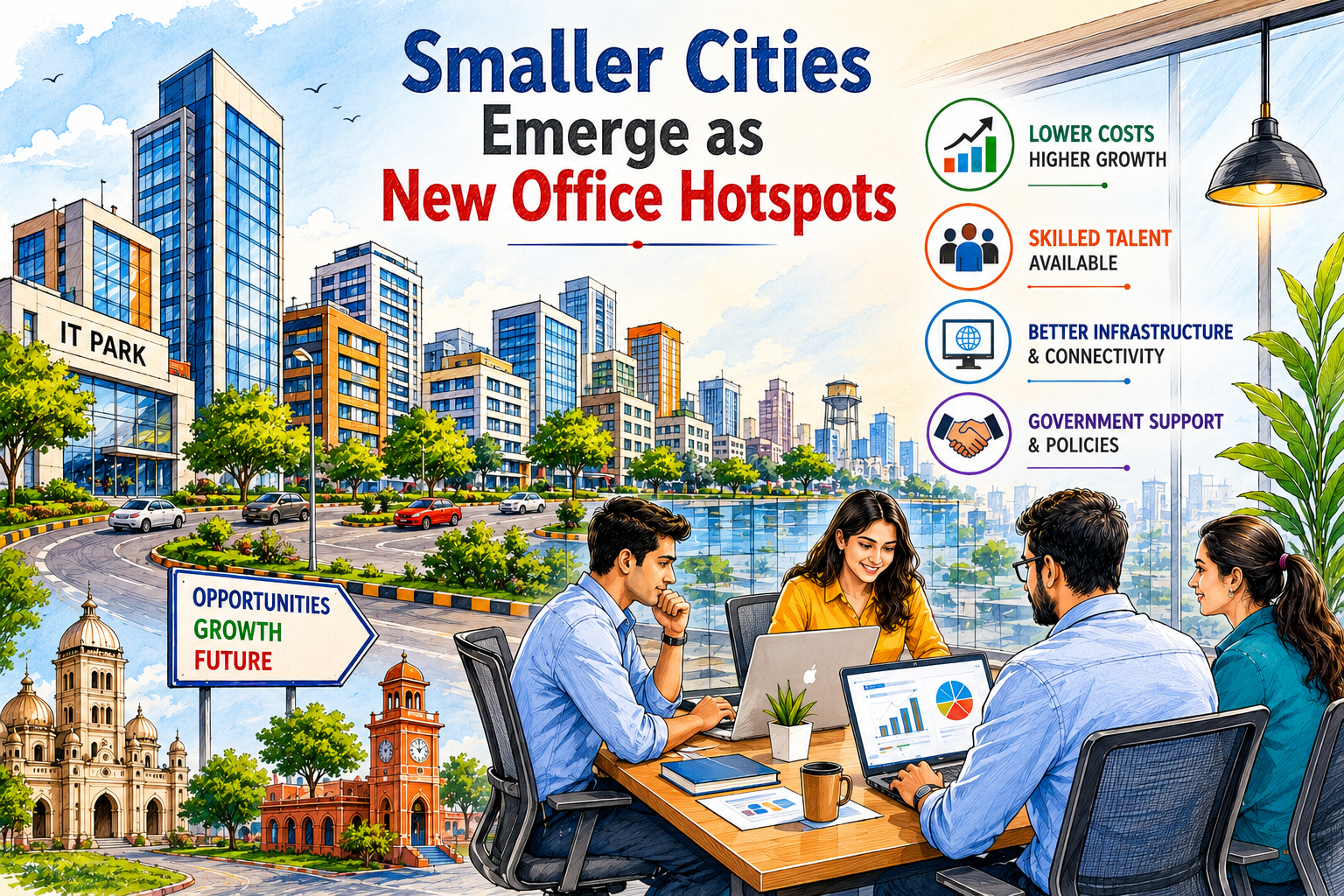
India’s commercial real estate landscape is undergoing a significant transformation. While metropolitan cities like Mumbai, Delhi, Bengaluru, Hyderabad, and Chennai have traditionally dominated the office market, a new trend is reshaping the country’s business geography. Smaller cities and emerging urban centers are rapidly becoming attractive office destinations for startups, multinational corporations, IT companies, Global Capability Centers (GCCs), and domestic enterprises. This shift is driven by lower operating costs, improved infrastructure, digital connectivity, skilled talent availability, and supportive government policies.

The COVID-19 pandemic accelerated the adoption of hybrid work models, encouraging companies to rethink their expansion strategies. Instead of concentrating operations in expensive metropolitan hubs, businesses are increasingly establishing offices in Tier-2 and Tier-3 cities such as Lucknow, Indore, Jaipur, Coimbatore, Kochi, Bhubaneswar, Chandigarh, Surat, Nagpur, and Visakhapatnam.
Why Smaller Cities Are Gaining Attention
One of the biggest attractions is cost efficiency. Office rentals in Tier-2 cities can be 40% to 70% lower than those in major metros. Lower employee salaries, affordable housing, and reduced operational expenses enable businesses to optimize costs while maintaining productivity.
Another important factor is the availability of skilled talent. Engineering colleges, universities, management institutes, and professional training centers across smaller cities are producing thousands of qualified graduates every year. Companies can recruit talented professionals locally, reducing dependence on costly relocation programs.
Improved infrastructure has also played a major role. Better highways, airports, metro rail systems, industrial corridors, and reliable internet connectivity have made these cities more business-friendly than ever before. Digital India initiatives and widespread broadband penetration have further supported remote and hybrid work environments.
The Rise of Global Capability Centers
Global companies are expanding their Global Capability Centers beyond traditional IT hubs. Many multinational corporations are exploring smaller cities to establish technology, finance, customer support, engineering, research, and innovation centers.
Lower employee attrition is another advantage. Professionals working in their hometowns often demonstrate greater job stability and improved work-life balance, helping organizations reduce hiring and training costs.
Government Support Driving Growth
State governments are actively competing to attract investments by offering incentives such as:
- Subsidized land and office space
- Tax benefits
- Startup incubation centers
- IT parks and SEZs
- Single-window business clearances
- Skill development initiatives
Programs like Startup India, Digital India, Smart Cities Mission, and various state industrial policies have significantly improved the ease of doing business in emerging cities.
Emerging Office Hotspots
Lucknow
Lucknow has emerged as one of North India’s fastest-growing commercial destinations. With expanding IT parks, educational institutions, government initiatives, and improved connectivity, the city is attracting startups, IT firms, consulting companies, fintech businesses, and professional service organizations.
Indore
Known as India’s cleanest city, Indore has become a preferred destination for IT companies and startups. Affordable real estate, excellent educational institutions, and proactive government policies continue to drive commercial growth.
Jaipur
Jaipur combines strong infrastructure with a rapidly growing startup ecosystem. Companies from IT, tourism, fintech, e-commerce, and digital services are increasingly setting up offices here.
Coimbatore
Coimbatore has transformed into a technology and manufacturing hub with strong engineering talent, industrial expertise, and lower operating costs.
Kochi
With the growth of Infopark and SmartCity Kochi, the city has attracted several multinational companies looking for skilled professionals in technology and business services.
Benefits for Employees
Employees are equally benefiting from this trend. Working closer to home reduces commuting time, lowers living expenses, improves family life, and enhances overall well-being. Affordable housing and better quality of life make smaller cities increasingly attractive to young professionals.
Hybrid work has also enabled employees to contribute to global organizations while residing in their hometowns, creating new employment opportunities outside metropolitan areas.
Opportunities for Startups
The startup ecosystem is rapidly expanding beyond Bengaluru and Delhi NCR. Entrepreneurs in smaller cities now have better access to incubators, venture capital, angel investors, government grants, and digital marketplaces.
Lower operational expenses allow startups to extend their financial runway while focusing on innovation and customer acquisition. Local entrepreneurship is also generating employment and boosting regional economies.
Challenges Remain
Despite the momentum, smaller cities still face several challenges:
- Limited Grade-A commercial office supply
- Public transport gaps
- Lower international flight connectivity
- Smaller corporate ecosystems
- Need for advanced digital infrastructure
- Limited availability of specialized professional services
However, these challenges are gradually being addressed through public and private investments.
The Road Ahead
India’s office market is becoming increasingly decentralized. Rather than relying solely on a few metropolitan cities, businesses are adopting a “hub-and-spoke” strategy by maintaining headquarters in major metros while expanding satellite offices across emerging cities.
Artificial intelligence, cloud computing, digital collaboration tools, and remote work technologies will continue to strengthen this trend. As infrastructure improves and talent pools expand, Tier-2 and Tier-3 cities are expected to contribute significantly to India’s next phase of economic growth.
Conclusion
The emergence of smaller cities as office hotspots represents a major shift in India’s business landscape. Cost advantages, abundant talent, improved infrastructure, government support, and changing workplace preferences are encouraging companies to expand beyond traditional commercial centers.
This transformation is not only creating new investment opportunities but also promoting balanced regional development, generating employment, and strengthening India’s position as one of the world’s fastest-growing business destinations. As organizations continue to embrace distributed work models, India’s emerging cities are poised to become the next engines of innovation, entrepreneurship, and sustainable economic growth.