









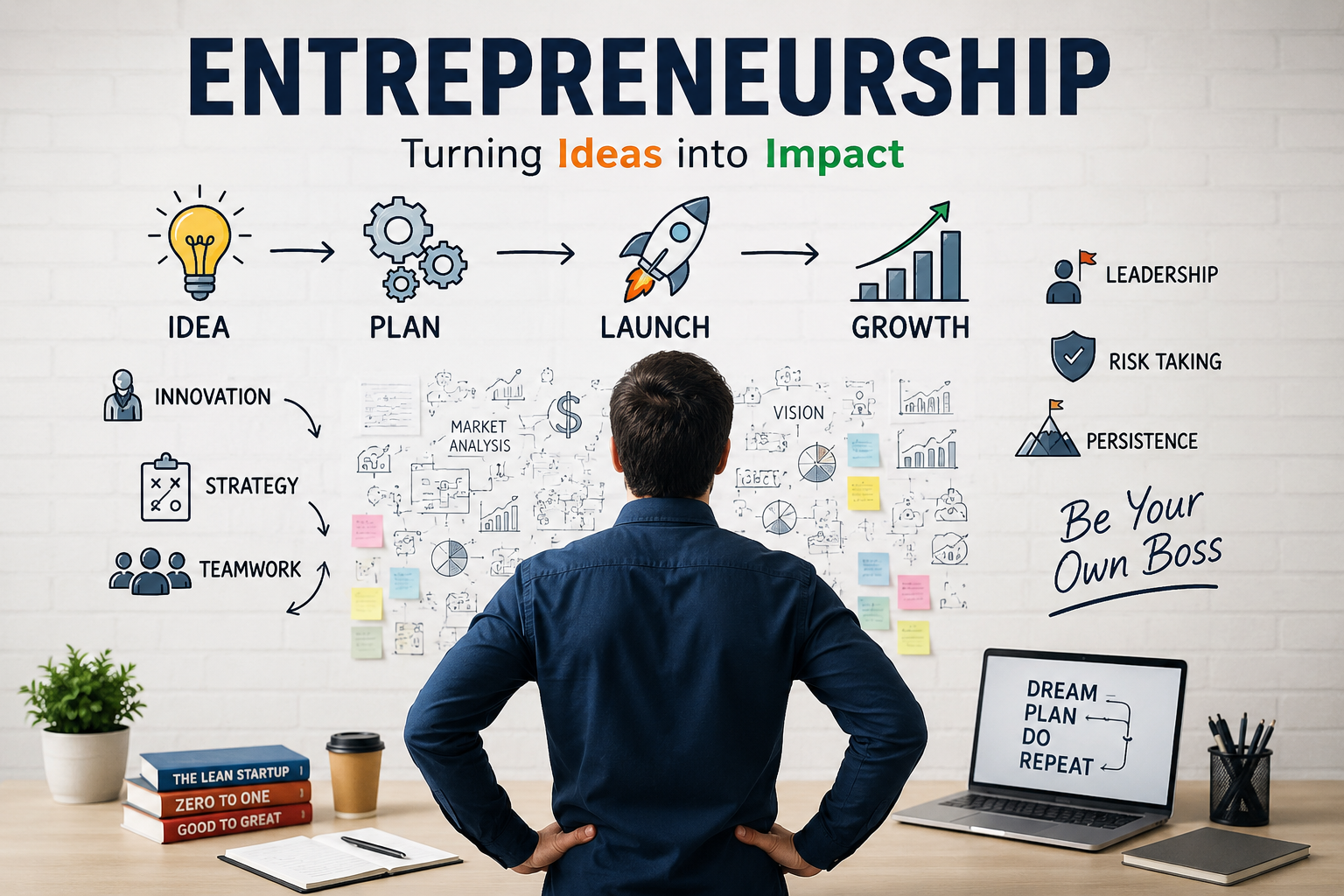
Every successful business begins with a simple idea. Whether it’s solving a common problem, improving an existing product, or introducing a completely new innovation, entrepreneurship starts with identifying an opportunity. However, turning an idea into a profitable startup requires careful planning, execution, and continuous learning.

According to industry reports, thousands of startups are launched every year, but only a small percentage survive beyond their first five years. The difference between success and failure often lies in preparation, market understanding, financial discipline, and adaptability.
If you’re planning to launch your own business, here’s a practical step-by-step guide to building a successful startup.
Step 1: Identify a Real Problem
Every great startup solves a genuine problem.
Instead of starting with a product, begin by asking:
- What challenges do people face daily?
- Can I make an existing solution better?
- Is there an underserved customer segment?
Successful companies such as Airbnb, Uber, and Canva gained traction because they addressed real customer pain points rather than creating unnecessary products.
Talk to potential customers, conduct surveys, and observe industry trends before investing time and money.
Step 2: Validate Your Business Idea
Many entrepreneurs make the mistake of assuming their idea will automatically attract customers.
Validation helps determine whether people are actually willing to pay for your solution.
You can validate your idea by:
- Conducting online surveys
- Interviewing potential customers
- Creating a landing page
- Running social media advertisements
- Launching a simple prototype
Customer feedback at this stage can save months of wasted effort and significant financial loss.
Step 3: Study Your Market and Competition
Understanding your competitors is essential.
Research businesses offering similar products or services and identify:
- Their strengths
- Their weaknesses
- Pricing models
- Customer reviews
- Marketing strategies
Your goal isn’t to copy competitors but to find opportunities where you can offer greater value or a better customer experience.
A clear Unique Value Proposition (UVP) helps customers understand why they should choose your startup over others.
Step 4: Create a Business Plan
A business plan acts as the roadmap for your startup.
It should include:
- Business objective
- Target audience
- Products or services
- Revenue model
- Marketing strategy
- Operational plan
- Financial projections
- Growth strategy
A well-prepared business plan also increases your chances of attracting investors, banks, and business partners.
Step 5: Build a Minimum Viable Product (MVP)
Instead of spending years developing a perfect product, create a Minimum Viable Product (MVP).
An MVP includes only the essential features needed to solve the customer’s problem.
Launching early allows you to:
- Receive real customer feedback
- Improve quickly
- Reduce development costs
- Minimize business risk
Many successful startups began with simple MVPs before evolving into global brands.
Step 6: Arrange Funding
Every startup requires capital, but not every business needs large investments initially.
Common funding options include:
- Personal savings
- Family and friends
- Angel investors
- Venture capital
- Government startup schemes
- Bank loans
- Crowdfunding
Raise only the amount you genuinely need and maintain financial discipline from the beginning.
Cash flow management is often more important than revenue during the early stages.
Step 7: Register Your Business
Choose the appropriate legal structure based on your country’s regulations.
This may include:
- Sole Proprietorship
- Partnership
- LLP (Limited Liability Partnership)
- Private Limited Company
- One Person Company (OPC)
Also complete:
- Business registration
- Tax registration
- GST (if applicable)
- Trademark registration
- Necessary licenses and permits
Protecting your intellectual property early can prevent future legal complications.
Step 8: Build Your Brand
Your brand is more than just a logo.
Develop:
- A memorable business name
- Professional logo
- Brand identity
- Website
- Social media presence
- Consistent messaging
Customers often trust businesses that appear professional, transparent, and consistent across all platforms.
Strong branding creates long-term customer loyalty.
Step 9: Launch and Market Your Startup
Even the best products fail without effective marketing.
Focus on reaching your target audience through:
- Content marketing
- Search Engine Optimization (SEO)
- Social media marketing
- Email marketing
- Influencer collaborations
- Google Ads
- Public relations
- Networking events
Measure marketing performance regularly and optimize campaigns based on customer data.
Marketing should be viewed as an ongoing investment rather than a one-time activity.
Step 10: Listen, Improve, and Scale
Successful entrepreneurs never stop learning.
Collect customer feedback continuously and monitor:
- Customer satisfaction
- Sales performance
- Website analytics
- Product reviews
- Market trends
Use these insights to improve products, expand into new markets, launch additional offerings, or automate operations.
Scaling should happen only after achieving product-market fit and establishing consistent customer demand.
Common Mistakes First-Time Entrepreneurs Should Avoid
Many startups fail because of avoidable mistakes, such as:
- Launching without market research
- Ignoring customer feedback
- Overspending in the early stages
- Hiring too quickly
- Weak financial planning
- Trying to serve everyone instead of a specific niche
- Giving up too early
Entrepreneurship is a long-term journey that requires resilience, adaptability, and patience.
Conclusion
Building a successful startup is not about having the perfect idea—it’s about executing that idea effectively. Entrepreneurs who understand customer needs, validate their concepts, manage finances wisely, and continuously improve their offerings stand a much better chance of long-term success.
Every globally recognized company once started as a simple idea backed by determination and consistent effort. With careful planning, a customer-first mindset, and the willingness to learn from setbacks, aspiring entrepreneurs can transform innovative ideas into sustainable businesses that create value, generate employment, and drive economic growth.
Remember, the journey from idea to startup is rarely linear. Challenges will arise, but each obstacle offers an opportunity to refine your vision and build a stronger, more resilient business. Success comes to those who stay focused, embrace change, and remain committed to solving real-world problems.