









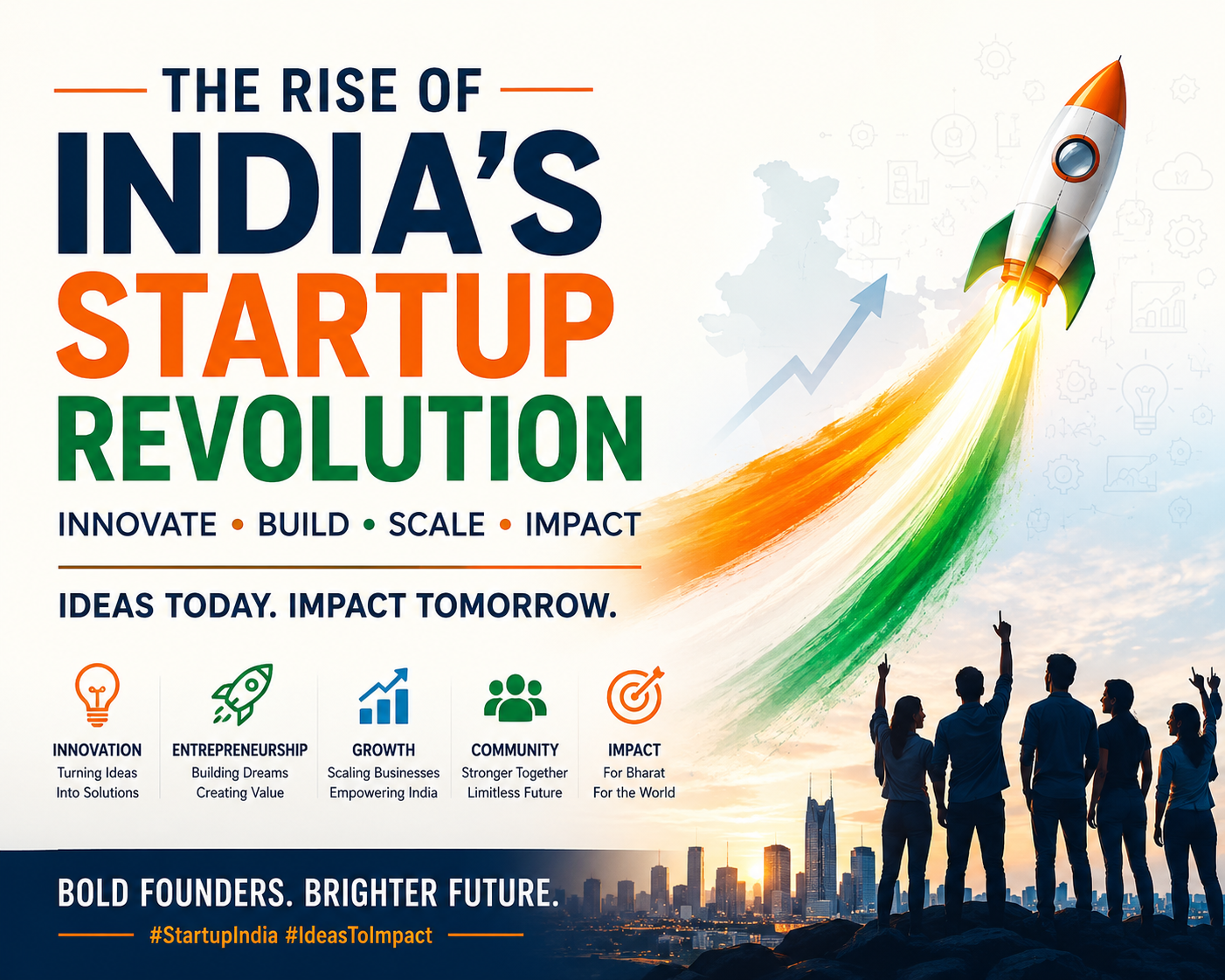
India is witnessing one of the most remarkable entrepreneurial transformations in modern history. Over the past decade, the country has evolved from being primarily known as a global outsourcing destination to becoming one of the world’s largest and most dynamic startup ecosystems. Today, thousands of startups across sectors such as technology, fintech, healthcare, education, agriculture, clean energy, and artificial intelligence are solving real-world problems while creating employment, driving innovation, and contributing to economic growth.

The rise of India’s startup revolution is not just about creating billion-dollar companies. It represents a fundamental shift in mindset—from seeking traditional employment to creating opportunities for others. Young entrepreneurs are increasingly choosing to build businesses that address local and global challenges, making India a hub for innovation and enterprise.
A New Era of Entrepreneurship
The startup movement in India has gained tremendous momentum due to several factors. Rapid internet penetration, affordable smartphones, digital payments, improved infrastructure, and supportive government initiatives have made it easier than ever to launch and scale businesses.
Programs such as Startup India, Digital India, Make in India, and Atal Innovation Mission have encouraged innovation by providing recognition, easier compliance, funding support, incubation, and mentorship opportunities. Educational institutions, incubators, accelerators, and industry organizations are also nurturing the next generation of entrepreneurs.
The emergence of digital platforms has significantly lowered entry barriers. Today, a founder can start an online business, market products through social media, receive payments digitally, and serve customers across India without investing heavily in physical infrastructure.
Innovation Across Every Sector
India’s startup revolution is not limited to software or technology. Entrepreneurs are building innovative businesses across diverse industries.
FinTech startups are expanding access to banking, digital payments, lending, insurance, and wealth management.
HealthTech companies are improving healthcare accessibility through telemedicine, diagnostics, AI-powered solutions, and affordable medical services.
EdTech startups are transforming learning with digital classrooms, skill development platforms, and personalized education.
AgriTech innovators are empowering farmers with precision agriculture, supply chain solutions, weather intelligence, and digital marketplaces.
CleanTech startups are addressing sustainability through renewable energy, electric mobility, waste management, and climate-focused innovations.
Artificial Intelligence, robotics, biotechnology, cybersecurity, and deep technology are emerging as the next growth engines of India’s startup ecosystem.
The Rise of Bharat Entrepreneurs
One of the most inspiring aspects of India’s startup revolution is the emergence of entrepreneurs from Tier-2 and Tier-3 cities. Innovation is no longer confined to Bengaluru, Mumbai, Delhi, or Hyderabad. Founders from cities such as Lucknow, Indore, Jaipur, Kochi, Bhubaneswar, Coimbatore, Surat, and Guwahati are building successful companies that solve regional challenges with scalable solutions.
These entrepreneurs understand local markets deeply and are creating products for millions of underserved consumers. Improved internet connectivity, digital infrastructure, and access to online learning have enabled talented individuals from every corner of the country to participate in India’s entrepreneurial journey.
This democratization of entrepreneurship is creating a more inclusive and resilient startup ecosystem.
Investment and Growth
India has become a preferred destination for global investors. Angel investors, venture capital firms, corporate funds, and government-backed initiatives are actively supporting promising startups.
While funding remains important, investors are increasingly focusing on businesses with sustainable revenue models, strong governance, customer-centric innovation, and long-term profitability. The emphasis has shifted from rapid expansion at any cost to building resilient businesses capable of generating lasting value.
Many Indian startups are now expanding internationally, serving customers across Asia, the Middle East, Europe, Africa, and North America, showcasing India’s ability to build globally competitive companies.
Challenges Ahead
Despite impressive growth, startups continue to face challenges. Access to early-stage funding, regulatory compliance, talent acquisition, infrastructure gaps, and intense competition remain significant concerns.
Entrepreneurs must also focus on responsible innovation, cybersecurity, data privacy, financial discipline, and sustainable business practices. Building a successful startup requires patience, resilience, adaptability, and continuous learning.
Failure should not be viewed as the end of the journey but as an opportunity to gain valuable experience and build stronger businesses.
The Future of India’s Startup Revolution
The future of India’s startup ecosystem looks exceptionally promising. Artificial Intelligence, quantum computing, space technology, biotechnology, climate innovation, advanced manufacturing, and digital public infrastructure will create entirely new entrepreneurial opportunities.
India’s young population, growing digital economy, expanding consumer market, and increasing global confidence position the country to become one of the world’s leading innovation hubs. As more universities encourage entrepreneurship, more women become founders, and more rural innovators gain access to technology and funding, the startup ecosystem will become even more diverse and impactful.
The next generation of Indian startups will not only create economic value but also solve critical challenges in education, healthcare, agriculture, sustainability, and financial inclusion.
Conclusion
India’s startup revolution is more than an economic movement—it is a national transformation driven by creativity, courage, and innovation. Entrepreneurs are redefining industries, generating employment, attracting investment, and improving lives through technology and purpose-driven businesses.
As India moves toward becoming a global innovation powerhouse, startups will continue to play a vital role in shaping the nation’s future. The journey has only just begun, and the opportunities ahead are limitless. For aspiring entrepreneurs, there has never been a better time to transform ideas into impactful businesses and contribute to building a stronger, more innovative, and self-reliant India.